
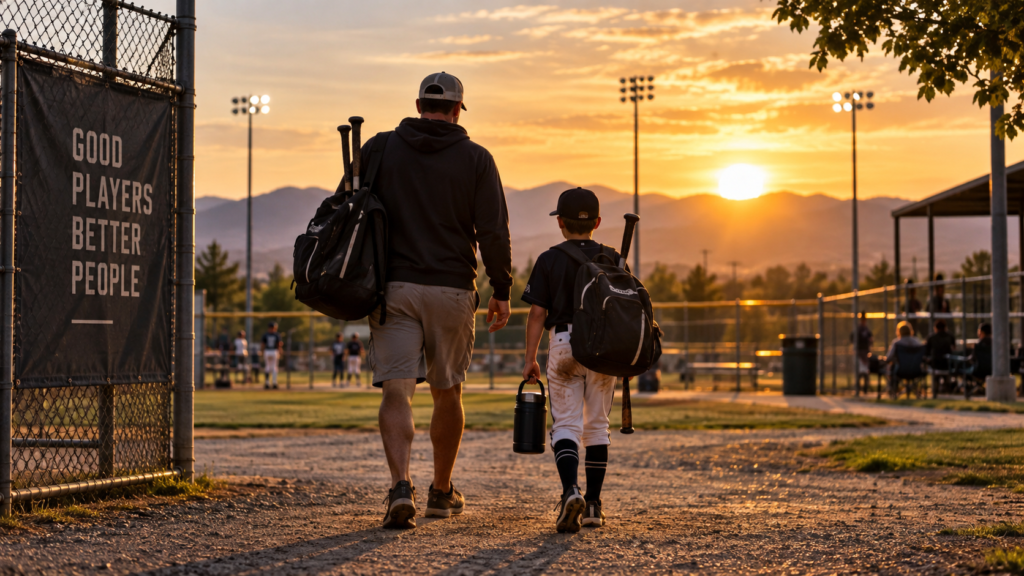
When our oldest son entered competitive travel baseball at 11 years old, my wife and I really had no idea what we were getting ourselves into.
He had always been a good athlete. He loved baseball. Moving into a more competitive environment felt like the natural next step.
So we jumped in.
What we couldn’t have known then was just how much travel baseball would eventually impact our entire family—the incredible memories it would give us, the money we would spend, the sacrifices we would make, the challenges our boys would face, and the lessons all five of us would learn along the way.
After going through the experience with three sons, I can tell you this:
Travel baseball can be an incredible experience for a kid and his family. But it can also become way more than you ever intended it to be.
There are plenty of things I wish someone had told me before we started.
1. The Team Fee Isn’t the Cost of Travel Baseball
This is probably the first surprise for new travel baseball families.
You see a team fee and think, Okay, that’s expensive, but we’ll figure it out.
Then the season starts.
There are hotels. Flights. Rental cars. Gas. Restaurants between games. Team dinners. Tournament admission. Uniforms. Batting gloves. Turf shoes. Metal cleats. Gloves. And, of course, the newest expensive bat that seemingly every kid suddenly needs.
Then come the lessons, offseason training, facility memberships, pitching instruction, hitting instruction and strength training.
It adds up incredibly quickly.
At one point, we had all three of our boys playing travel baseball at ages 14, 11 and 9.
We estimated that between January and August that year, our family spent more than $20,000 on baseball.
That was a wake-up call.
Did our boys improve that year? Absolutely.
Did we make some incredible memories? Yes.
But we also realized that $20,000 could have paid for a couple of unforgettable family vacations and experiences that had nothing to do with baseball.
Neither choice is automatically right or wrong.
The point is that families should understand the real cost before making the commitment.
2. More Money Doesn’t Automatically Mean More Development
Youth baseball can start to feel like an arms race.
Another kid is taking private hitting lessons, so maybe yours should too.
Someone starts strength training.
Someone buys the latest bat.
Another player joins an elite offseason program.
A club introduces new technology, facilities or training and suddenly its fees increase again.
We’ve experienced organizations that offered plenty of expensive bells and whistles that, in reality, didn’t make much difference. Sometimes it was development. Sometimes it was mostly marketing.
If I were starting over, I’d put less emphasis on finding the most expensive or prestigious team and more emphasis on finding appropriate competition, great coaching and actual player development.
Then I’d spend selectively on quality individual instruction when my child genuinely needed it.
A great hitting or pitching coach can make an enormous difference.
But simply throwing more money and more baseball at a kid doesn’t guarantee a better baseball player.
Sometimes it just produces a kid who’s tired of baseball.
3. The Coach Matters More Than the Logo on the Jersey
Of all the decisions we made over the years, I believe choosing the right coach had one of the biggest impacts on our boys.
We’ve experienced both ends of the spectrum.
We’ve had incredible coaches who challenged our sons, held them accountable, taught them the game and helped them become better young men.
We’ve also experienced coaching that I would describe as genuinely damaging. Coaching that crossed the line from being demanding into being unnecessarily harsh, personal or inappropriate.
Those experiences can leave a mark on a kid.
If I could give parents one piece of advice when evaluating a team, it would be this:
Don’t just evaluate the team’s record. Evaluate the person who will be coaching your child.
Look for a coach who can balance structure, discipline and accountability with an environment where kids are still allowed to enjoy playing baseball.
The goal shouldn’t simply be to win tournaments at 11, 12 or 13 years old.
The goal should be for your son to become a better baseball player, a better teammate and, most importantly, still want to play baseball next year.
And if you have the opportunity, go watch the team play before committing.
Don’t just watch the baseball.
Watch the coach after a kid makes an error. Watch the dugout. Watch how the players interact. Watch the parents in the stands.
Are parents encouraging the kids? Or are they sitting in cliques criticizing players and coaches?
You can learn a tremendous amount about a baseball team without ever looking at the scoreboard.
4. Your Kid Is Going to Fail — A Lot
Baseball might be the greatest teacher of failure I’ve ever seen.
Think about it.
A hitter who gets three hits in ten at-bats is having a pretty good season. In most areas of life, succeeding 30% of the time wouldn’t exactly earn you a trophy.
In baseball, you’re probably one of the better hitters on the team.
All three of our boys have gone through stretches where they were hot and everything seemed easy. They’ve also gone through slumps where it felt like they couldn’t buy a hit.
As a parent, those stretches can be incredibly difficult to watch.
Your instinct is to fix it.
Give advice. Find another hitting lesson. Analyze the swing. Say something encouraging on the drive home.
Sometimes the best thing we can do is give them the space to figure it out.
Because eventually baseball forces kids to learn something much bigger than how to hit a curveball:
They learn how to fail without believing they’re a failure.
They learn how to take constructive criticism. How to respond after getting benched. How to compete for a position. How to come back tomorrow after going 0-for-4 today.
And sometimes the challenges are much bigger than a slump.
Our oldest son was a talented pitcher who injured his arm during his sophomore year of high school, right when it looked like he might have an opportunity to see some varsity time.
For him, it was devastating.
Pitching had always been one of those things that came naturally to him. Suddenly, something that felt like part of his identity as a baseball player was gone.
But he worked.
He rehabbed. He adjusted. He found other ways to contribute and kept going.
By his junior year, he had worked his way back and earned a starting spot on varsity.
I’m proud of the baseball accomplishment.
But I’m much prouder of what it took for him to get there.
Resilience. Patience. Humility. Work ethic. Learning how to deal with something not going according to plan.
Those lessons will matter long after his last baseball game.
And that’s one of the things I’ve come to appreciate most about this sport.
Baseball has taught our boys lessons about competition, relationships, communication, adversity and perseverance that will follow them into college, their careers, their marriages and someday, if they choose, raising families of their own.
The baseball eventually ends.
The person it helped build doesn’t.
5. Playing Time Isn’t Your Battle to Fight
If you’ve been a sports parent long enough, you’ve probably sat in the stands thinking:
Why isn’t my kid playing?
Why is he batting there?
Why isn’t he playing that position?
My wife and I had those thoughts plenty of times over the years.
What we tried very hard not to do was turn those frustrations into our sons’ frustrations.
We made a deliberate decision that playing time, lineup position and where they played on the field generally weren’t battles we were going to fight for them.
Instead, we tried to turn those moments into a question:
What can you do to earn it?
Work harder. Get better. Ask what you need to improve. Make it difficult for the coach to keep you out of the lineup.
I believe that approach served our boys well, especially as they got older and the competition became more serious.
Because eventually there are no guarantees.
There are no participation trophies for varsity playing time. Someone else may simply be better than you. And learning how to respond to that is an important part of growing up.
That doesn’t mean a player should never talk to his coach.
One of our sons experienced this while playing 16U baseball as a 15-year-old. He believed he had earned the opportunity to play a particular position, but his coach continued playing him elsewhere.
We were frustrated. He was frustrated.
But instead of my wife or me approaching the coach, we encouraged our son to have the conversation himself.
He respectfully explained why he believed he had earned an opportunity at the position and asked the coach for his perspective.
The coach explained his reasoning. Our son listened. The coach listened to him.
Not long afterward, he got an opportunity at the position and was successful there.
The position wasn’t actually the most important part of that story.
Learning how to respectfully advocate for himself was.
Someday your kid is going to have a professor, a boss, a coworker or someone else making a decision he doesn’t agree with.
Mom and Dad won’t be able to walk into the office and fix it.
Baseball gives our kids an opportunity to start learning how to handle those conversations while we’re still close enough to help guide them through it.
6. Protect Your Family From Baseball
This is probably the advice I wish we’d understood the most when we started.
Baseball will take as much of your family’s life as you’re willing to give it.
And if you’re not careful, that can become almost everything.
When our oldest first started travel baseball, we weren’t prepared for three or four practices a week and a schedule that could approach 70 games between February and July.
Then multiply that across three boys.
Practices. Games. Lessons. Tournaments. Hotels. Flights. Weekends divided between different fields.
Somewhere along the way, it becomes very easy for your family calendar to turn into a baseball calendar.
Looking back, there are weekends I wish we’d protected.
There are vacations I wish we’d taken.
There are lazy Saturdays where I wish we’d slept in, gone somewhere new, visited family or simply done absolutely nothing together.
And there’s another part of this that doesn’t get talked about enough.
Travel sports can put stress on a marriage.
My wife and I experienced it.
Money. Schedules. Who is taking which kid where. What we’re missing. Whether we’re spending too much. Whether one child is getting more attention than another. Whether this team is still worth it.
Baseball gave our family some incredible moments together, but there were also difficult nights and difficult conversations.
If we could start over, we would put boundaries around baseball from the very beginning.
We’d decide how much money we’re willing to spend.
We’d decide how much time we’re willing to give.
We’d protect weekends that have absolutely nothing to do with baseball.
We’d take the family vacation.
We’d make sure our other children weren’t constantly rearranging their lives around one brother’s baseball schedule.
And my wife and I would make sure we were still making time for each other.
Because here’s something that’s easy to forget when you’re standing beside a field every weekend:
You’re raising a family that plays baseball. You’re not building a family around baseball.
There’s a big difference.
The tournament you think you absolutely cannot miss probably won’t matter five years from now.
The relationships you’re building during those years absolutely will.
7. Know When It’s Time to Walk Away
One mistake we made more than once was staying too long.
Staying with a team because we’d already committed.
Staying because our son had friends there.
Staying because we’d already paid the money.
Staying because we kept convincing ourselves that maybe things would get better.
Looking back, there were situations where the signs were pretty obvious.
Our son wasn’t enjoying himself anymore. The coaching wasn’t a good fit. The environment had changed. The schedule was putting too much pressure on our family. Or we simply realized that what the team was offering no longer matched what our son needed.
And yet, sometimes we stayed.
There’s a natural tendency as a parent to think quitting or leaving means you’re teaching your child to give up when things get difficult.
I don’t believe that anymore.
There’s a difference between teaching your child perseverance and teaching him to remain in an unhealthy situation simply because he started it.
That’s an important distinction.
Kids absolutely need to learn how to work through adversity. They shouldn’t leave a team because they went 0-for-4, lost their starting position or got constructive feedback they didn’t like.
But when baseball consistently becomes a source of anxiety, unhappiness or dread, it’s worth paying attention.
Ask yourself some simple questions.
Is my son still developing?
Is he being treated appropriately?
Does he enjoy being around his teammates?
Is this environment helping him grow?
And maybe most importantly:
Does he still look forward to going to the baseball field?
Sometimes the answer will be yes, and you help him push through a difficult season.
Sometimes the answer will tell you it’s time for a change.
I wish we’d trusted that instinct sooner a few times.
There will always be another team, another tournament and another baseball season.
You don’t get those years with your kid back.
8. The Trophies Aren’t What They’ll Remember
Somewhere in our house is a box filled with baseball medals, rings and trophies.
At one point, those things felt pretty important.
Tournament championships. Weekend victories. Individual awards. All the little pieces of hardware that seem to matter so much when you’re living in the middle of youth baseball.
Then something interesting happened.
Before our boys even reached high school, each of them basically did the same thing.
They gathered up their medals, rings and trophies, handed them to me and said some version of:
“Dad, you can have them. I don’t really want them anymore.”
I think about that a lot.
We spent countless weekends chasing those trophies.
And eventually, they ended up in a box.
That’s not to say winning doesn’t matter. Winning is fun. Competing to win is part of sports, and I want my kids to compete every time they step on the field.
But years later, the wins aren’t what they talk about.
They remember hitting their first home run.
They remember throwing harder than they’d ever thrown before.
They remember making the diving play they didn’t think they could make.
They remember getting stronger, faster and better.
And they definitely remember the stuff that had almost nothing to do with baseball.
The hotel pools.
The ridiculous conversations in the dugout.
The team dinners.
Staying up too late in hotel rooms.
Messing around with teammates between games.
The road trips.
The friendships.
Those are the things that lasted.
Kids remember how baseball made them feel far longer than they remember the score.
That’s something I wish I’d understood better when our oldest was 11.
The goal isn’t to collect the most rings before high school.
The goal is to give your kid an experience that helps him grow, gives him memories and hopefully leaves him loving the game.
Because someday there won’t be another tournament on the calendar.
And when that day comes, you want your kid to be able to look back and say:
“Man, that was fun.”
Not simply:
“We won a lot.”
9. So… Was Travel Baseball Worth It?
After everything I’ve written here, you might expect me to say we wouldn’t do it again.
That’s not true.
If you asked my wife and me whether travel baseball was worth it, I think we’d both say yes.
But that yes comes with some perspective we didn’t have when we started.
We’d spend less money.
We’d protect more of our time.
We’d take more family vacations.
We’d worry less about which team was ranked where, who was batting where and which tournament we absolutely had to play in.
We’d recognize bad situations sooner and be more willing to make a change.
And we’d remind ourselves more often that none of this lasts forever.
But would we give back the experiences?
No.
Baseball has taken our family places we probably never would have gone. It’s introduced our boys—and us—to people we never would have met.
We’ve watched our sons experience success, failure, disappointment, injury, competition, friendship and some incredible moments.
We’ve watched them learn how to win.
More importantly, we’ve watched them learn how to lose.
We’ve watched them become better teammates, better communicators and more resilient young men.
And we’ve made memories as a family that I’ll carry with me for the rest of my life.
So if you’re the dad sitting at home right now wondering whether your 10-, 11- or 12-year-old should try travel baseball, here’s what I’d tell you:
If your son loves baseball, he wants to do it, and your family is ready for the commitment, go for it.
Just don’t lose perspective along the way.
Don’t let somebody else’s kid determine what you spend on yours.
Don’t confuse winning with development.
Don’t assume the most expensive organization is the best organization.
Don’t let a baseball schedule completely replace your family schedule.
And don’t become so focused on where baseball might take your son someday that you miss where you are with him right now.
Help him get bigger. Stronger. Faster. More confident.
Celebrate the first home run.
Celebrate the diving catch.
Celebrate the personal record that nobody else in the stands even knows happened.
Let him laugh with his teammates.
Let him fail.
Let him figure some things out on his own.
And every once in a while, forget about baseball completely and go do something together as a family.
Because someday the uniforms won’t fit anymore.
The bats will be sitting in the garage.
The medals will be in a box.
And you’ll realize that what you were really building all those years wasn’t a baseball player.
You were raising your son.
Baseball was just lucky enough to be part of it.